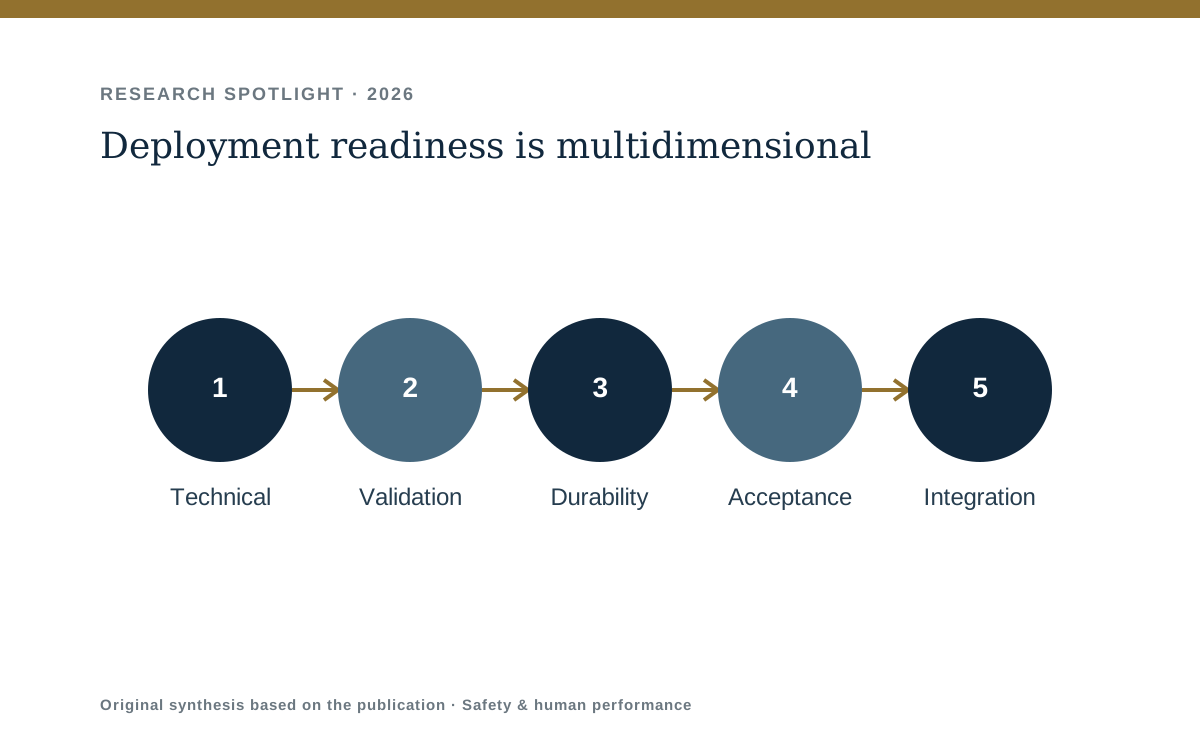
The multidimensional readiness framework helps researchers and safety teams evaluate whether a garment can survive real work, fit workflows, protect worker interests, and produce information that can support decisions.
Safety & human performanceSystematic reviewJournal article
RESEARCH IN VIDEO
The ideas behind the papers.
Watch an explanation, explore the findings, and read the full study.
Smart garment reality check: from prototype to practice
How close are sensor-equipped garments to everyday construction use? This video explains a PRISMA-guided systematic review of 76 records, including 63 empirical records used for benchmarking. The study separates construction-direct evidence from findings transferred from other fields and examines what sustainable deployment requires.
Key findings from the paper
Only 7 of 63 empirical records (about 11%) were field or field-simulated; 6 reached technology readiness level 5. Most evidence still came from laboratory evaluations.
The corpus distinguishes 18 construction-direct records, 45 transferable records, and 13 contextual sources. Results from healthcare, sports, and rehabilitation therefore require careful interpretation before application to construction.
A five-dimensional framework examines technical performance, validation maturity, operational durability, human and organizational acceptance, and system integration. Across seven field or field-simulated records, durability, validation, and integration emerged as recurring gaps—a preliminary signal rather than a generalizable conclusion.
Smart garments can continuously measure physiological and movement signals, but most systems never progress beyond controlled laboratory trials. The review asked what is keeping technically promising garments from sustainable construction-site deployment.
What we did
A PRISMA-guided review synthesized 76 records published from 2000 through 2026; 63 empirically validated studies were used for benchmarking. Evidence was classified by construction relevance, validation context, transferability, and readiness across technical, operational, human, organizational, and integration dimensions.
What we found
Only 7 of 63 empirical records (11%) involved field or field-simulated validation.
Six of those field-oriented systems reached Technology Readiness Level 5; most other systems remained at Level 4.
Validation maturity, durability, acceptance, and system integration were more persistent constraints than technical performance alone.
Why it matters
The multidimensional readiness framework helps researchers and safety teams evaluate whether a garment can survive real work, fit workflows, protect worker interests, and produce information that can support decisions. Read together, the question, method, and findings show how this publication fits within Tafazzoli’s broader program of connecting built-environment evidence with practical decisions. The page intentionally separates documented results from interpretation and directs readers to the complete paper for methodological detail. The study also illustrates a recurring principle across this research portfolio: a useful result must be understood in its original setting before it is transferred to another project, organization, population, or policy context.
Deployment readiness is multidimensional. This original synthesis graphic is based on the study’s documented question, method, or principal contribution; consult the paper for complete figures, labels, units, and uncertainty.
Original website synthesis based on the cited publication.
From laboratory prototype to sustainable deployment: Smart garment technologies for construction safety monitoring and a multidimensional readiness framework
Published · 2026 · Journal article
Tafazzoli, M., Haq, I., Naeijian, F., Goodarzi, M., & Kamari, M. (2026). From laboratory prototype to sustainable deployment: Smart garment technologies for construction safety monitoring and a multidimensional readiness framework. Sustainability, 18(16), 8359. https://doi.org/10.3390/su18168359