GEORGIA SOUTHERN UNIVERSITY · FOUNDER & DIRECTOR: TOMMY TAFAZZOLI

S.A.F.E. Lab

Safety, Applied Research, Fatigue, and Ergonomics

Developing practical, evidence-based approaches to construction-worker safety, human performance, fatigue management, and technology adoption.
S.A.F.E. Lab wearable safety research poster featuring a construction worker wearing physiological sensorsWEARABLE SENSING · HUMAN PERFORMANCE · CONSTRUCTION SAFETY
FATIGUE · PHYSIOLOGICAL SENSING · HUMAN FACTORS · FIELD INTERVENTION

CURRENT RESEARCH

Understanding the worker. Improving the work.

PUBLISHED RESEARCH

Fatigue monitoring & worker trust

Published research examines how construction professionals perceive, trust, and prefer subjective, objective, and hybrid fatigue-monitoring approaches.

PUBLISHED RESEARCH

Smart-garment deployment readiness

A published multidimensional framework examines what smart-garment technologies need to progress from laboratory prototypes to sustainable deployment.

FUNDED FIELD RESEARCH

Stay Sharp, Stay Safe

The Job-Site Safety Institute-funded field-intervention project is developing low-burden, bilingual fatigue-reset tools for workers and supervisors.

LABORATORY CAPABILITY
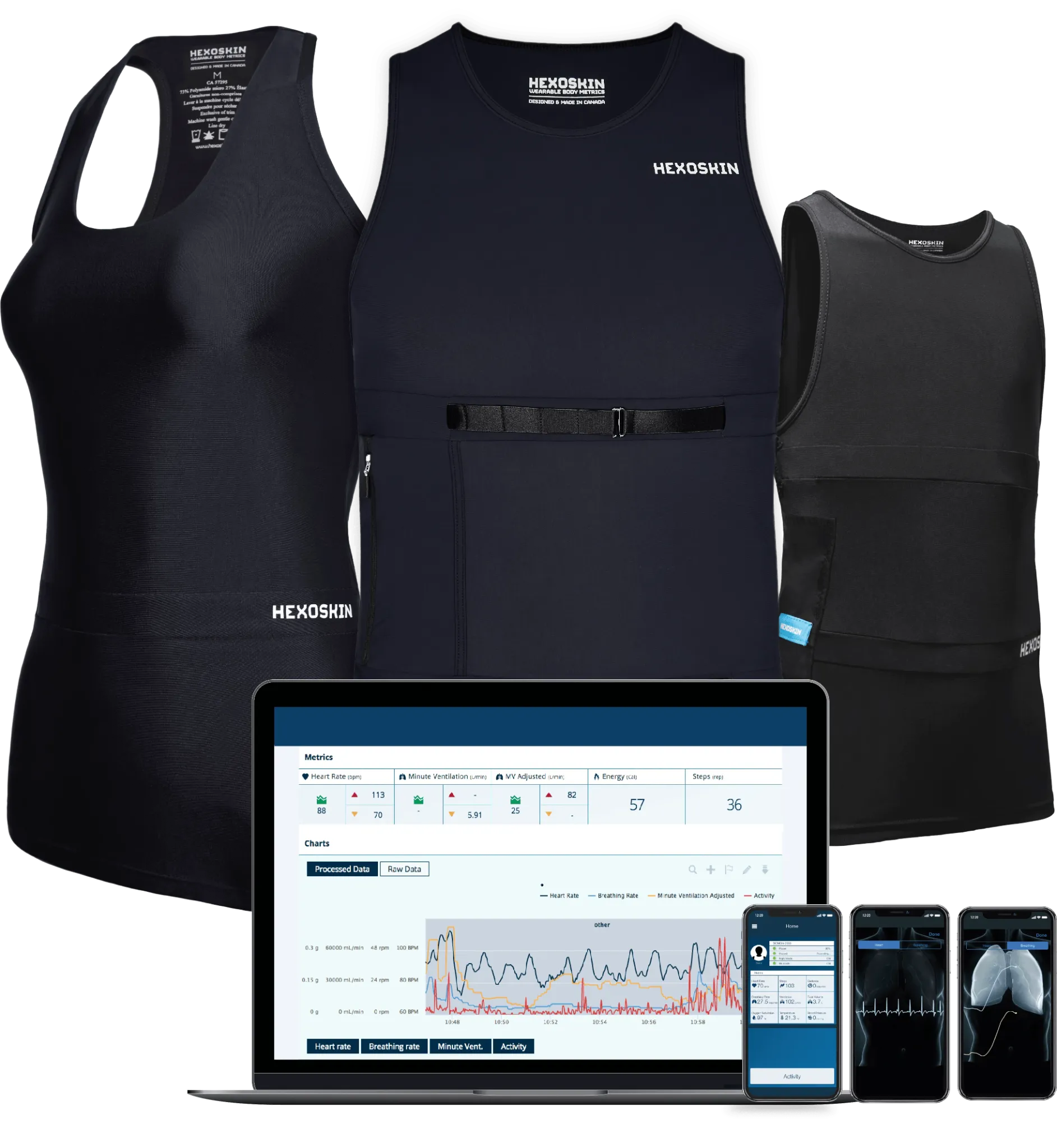
Wearable and physiological measurement.

Research themes include heart-rate variability, multimodal sensing, worker trust, technology adoption, intervention, and predictive analytics.

RESEARCH COMMUNICATION

The S.A.F.E. Lab visual portfolio.

View in the photo gallery ↗
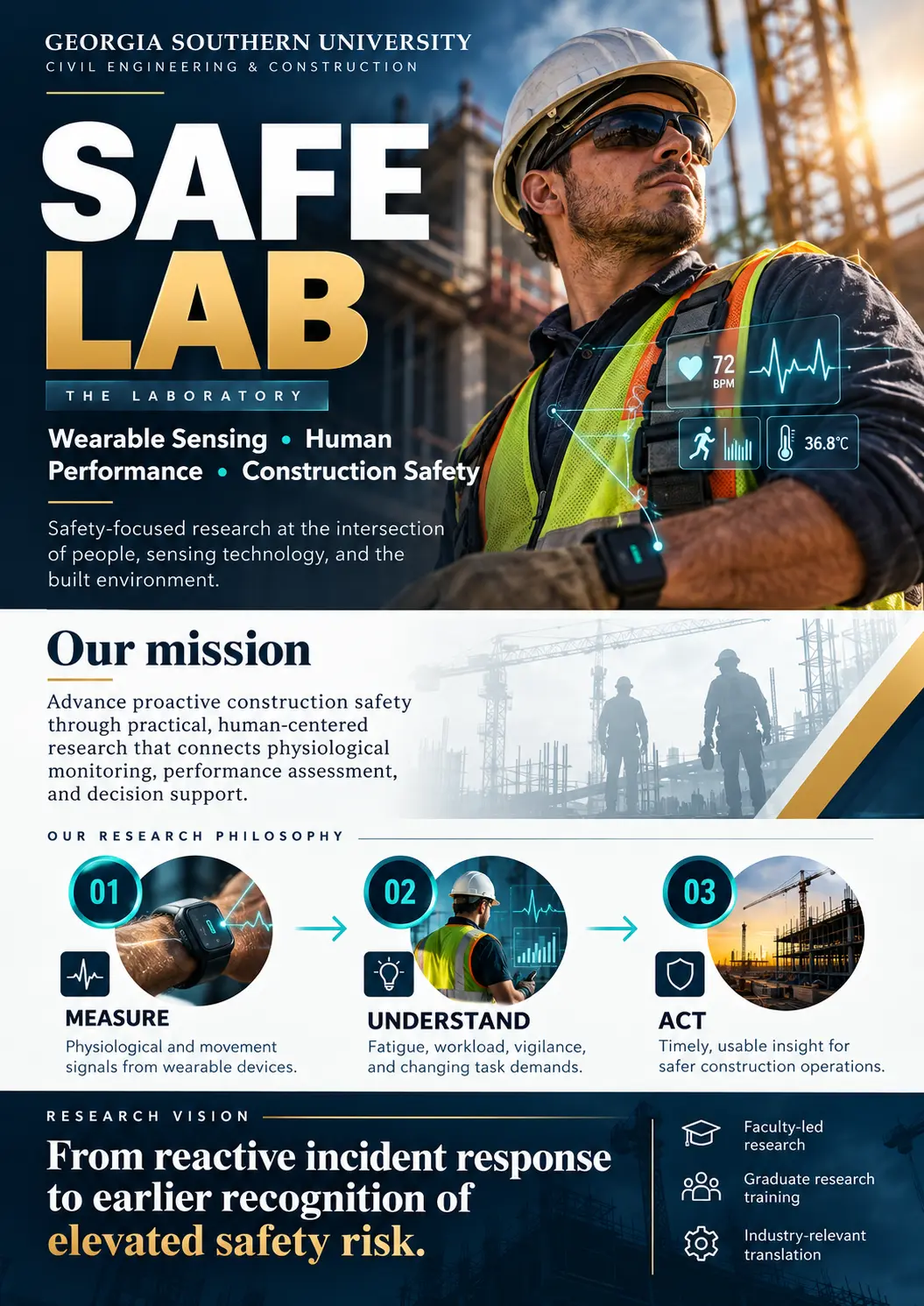
S.A.F.E. Lab poster showing a construction worker wearing physiological sensors and the Measure, Understand, Act research philosophy.
Wearable safety researchThe S.A.F.E. Lab mission connects physiological and movement signals with worker-centered construction-safety decisions.
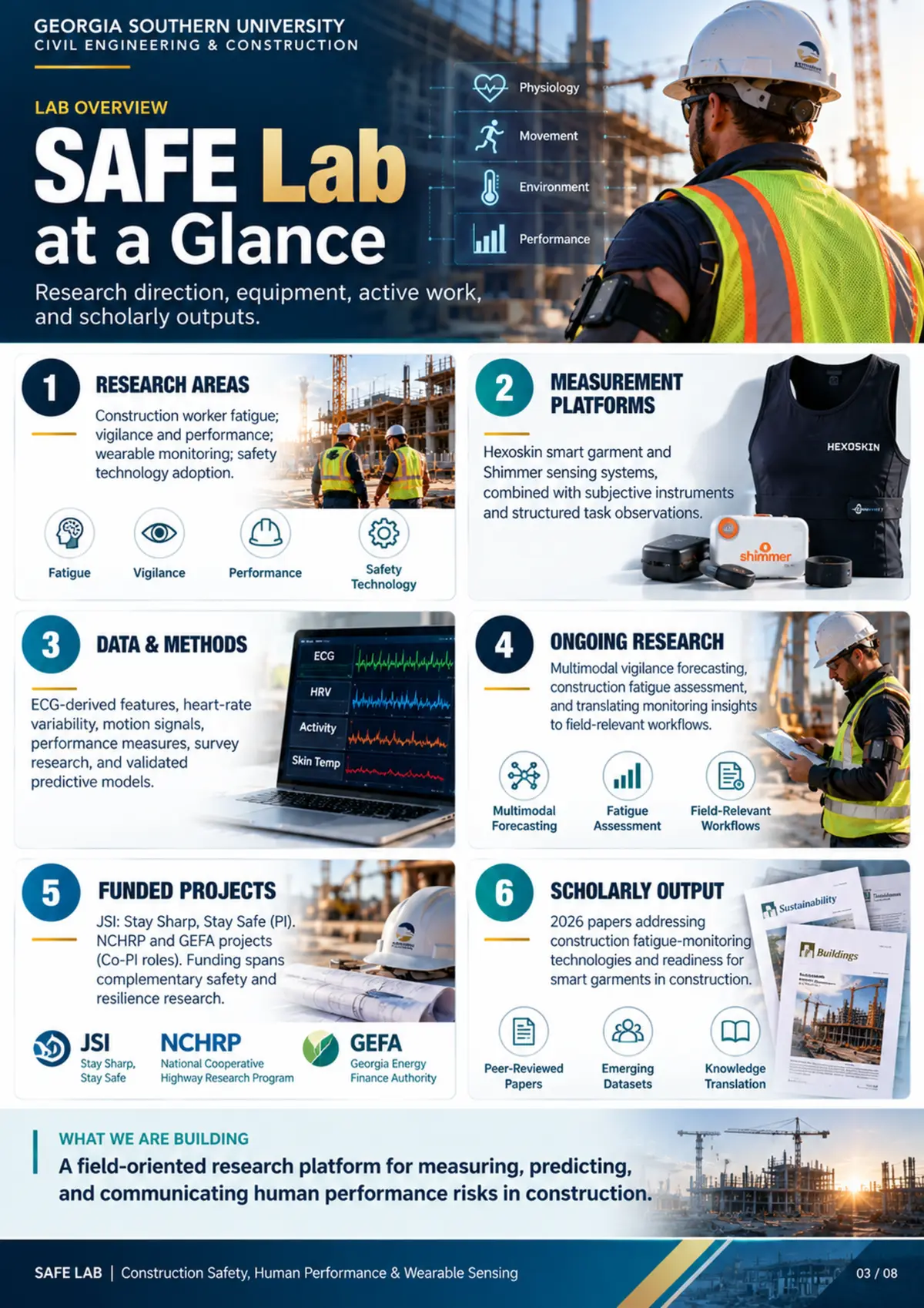
S.A.F.E. Lab overview poster with six sections covering research areas, Hexoskin and Shimmer platforms, data methods, ongoing research, funded projects, and scholarly output.
S.A.F.E. Lab at a glanceAn overview of research areas, wearable measurement platforms, funded projects, analytical methods, and scholarly output.
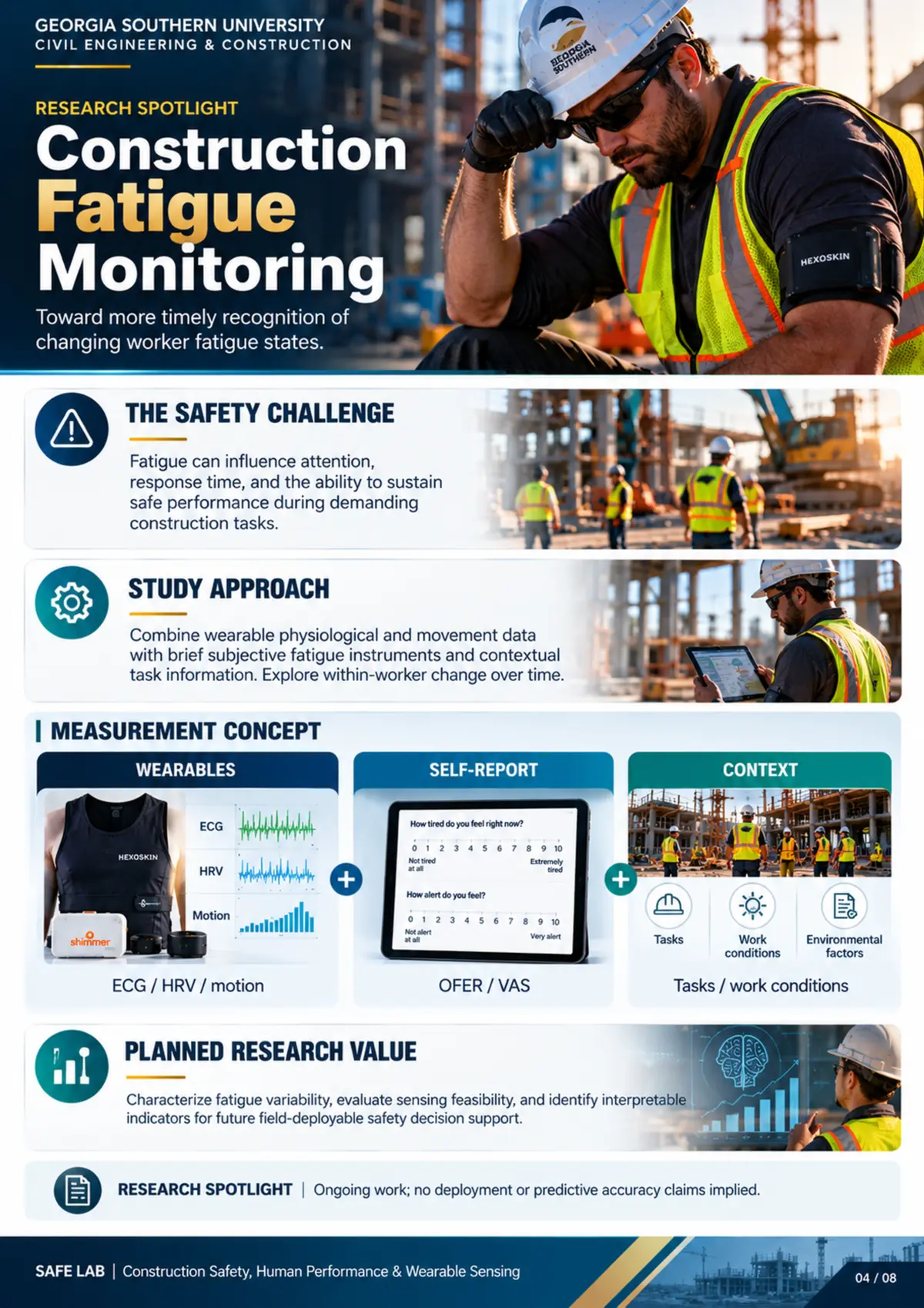
Construction fatigue monitoring poster illustrating the safety challenge, study approach, wearable and self-report measurements, work context, and planned research value.
Construction fatigue monitoringA research concept combining wearable signals, worker self-reports, and jobsite context to study changing fatigue states.
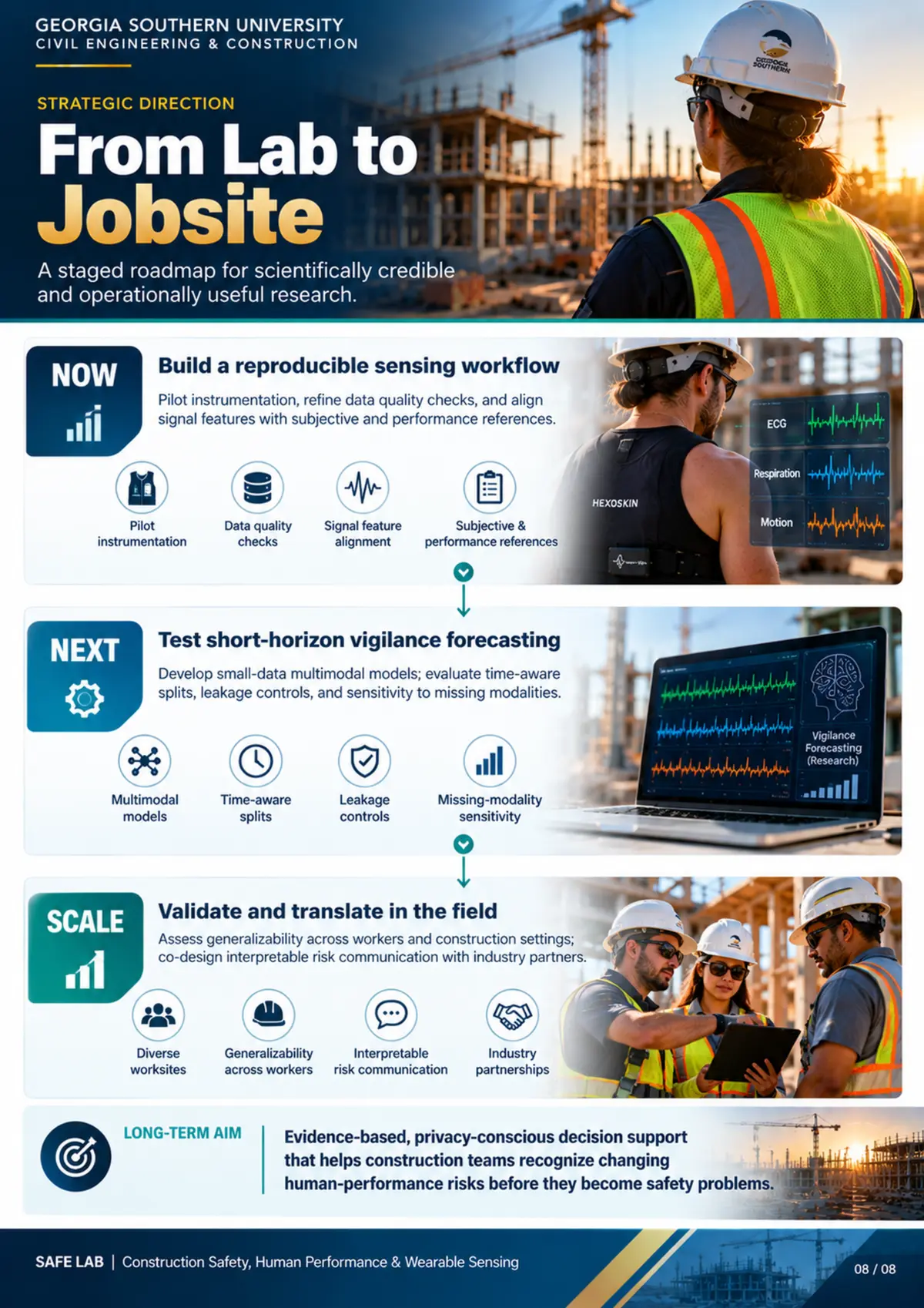
S.A.F.E. Lab roadmap poster progressing from a reproducible sensing workflow to vigilance forecasting and field validation on construction jobsites.
From lab to jobsiteA staged roadmap for developing reproducible sensing workflows, testing short-horizon vigilance forecasting, and translating evidence to field settings.
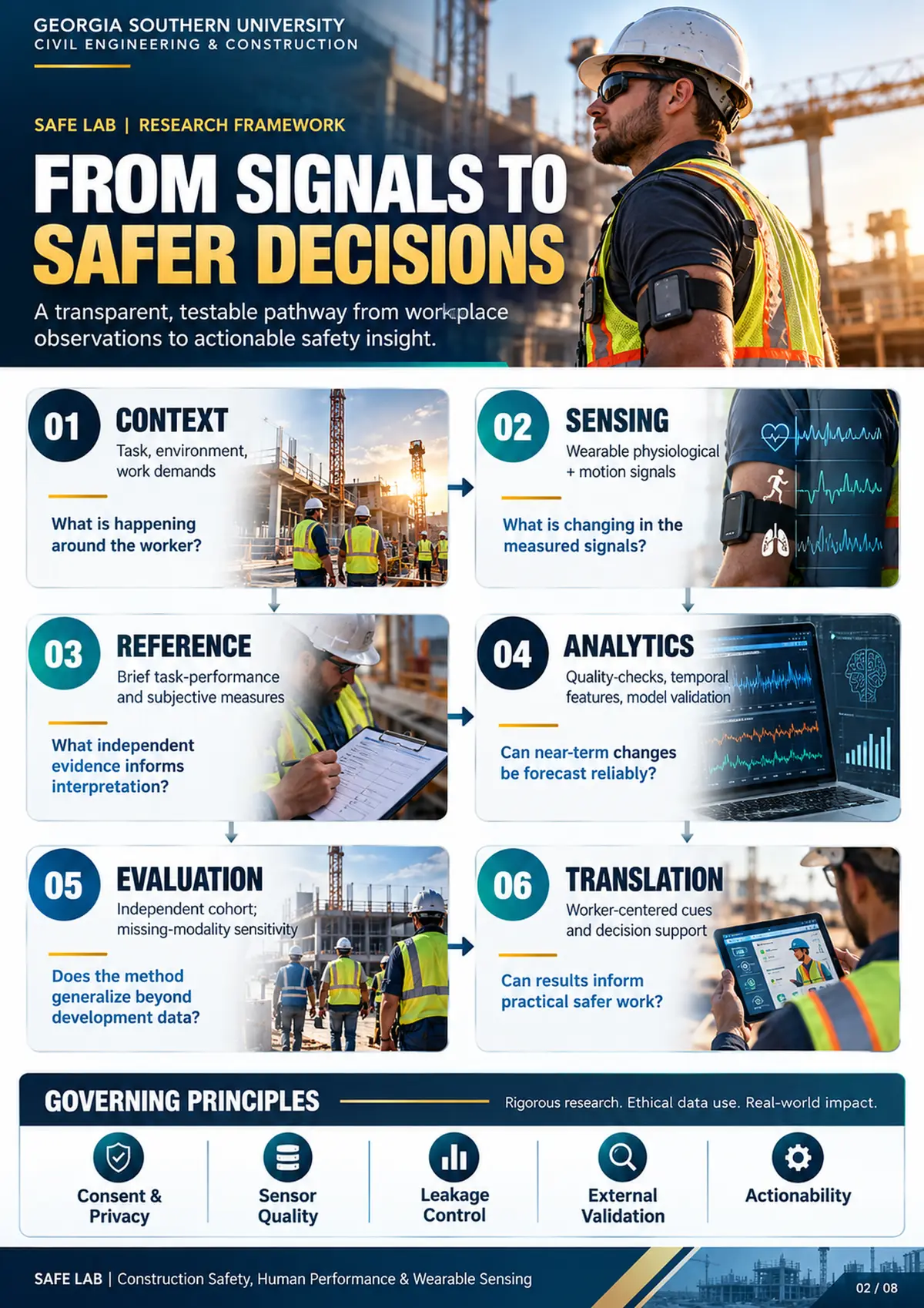
S.A.F.E. Lab research framework poster showing six stages: context, sensing, reference, analytics, evaluation, and translation, with governing research principles.
From signals to safer decisionsThe lab's six-stage framework moves from context and sensing through reference measures, analytics, independent evaluation, and practical translation.
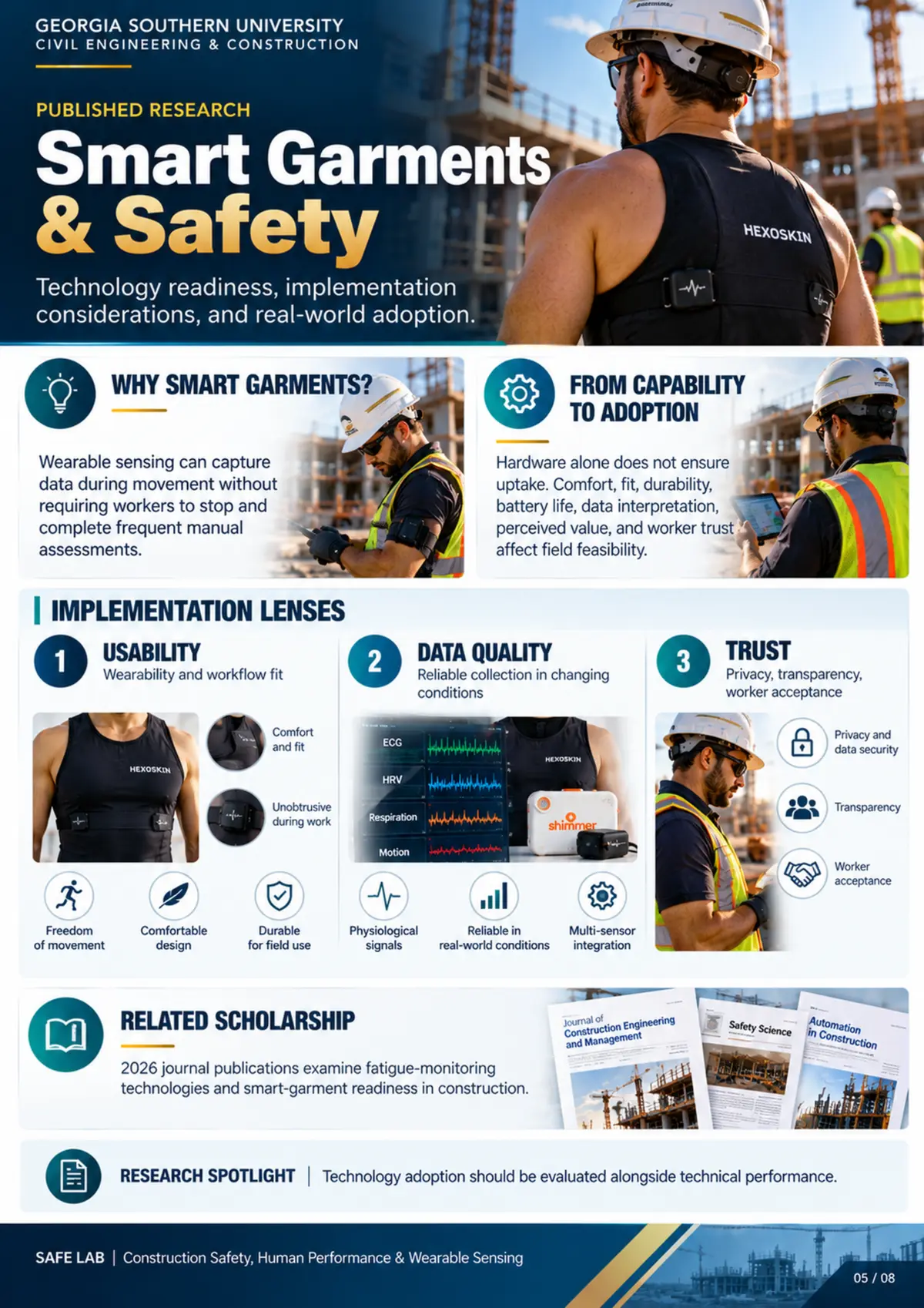
Smart garments and construction safety poster describing wearable monitoring, technology adoption, usability, data quality, trust, and related scholarship.
Smart garments and safetyPublished research examines smart-garment usability, data quality, trust, and the conditions required for responsible field adoption.
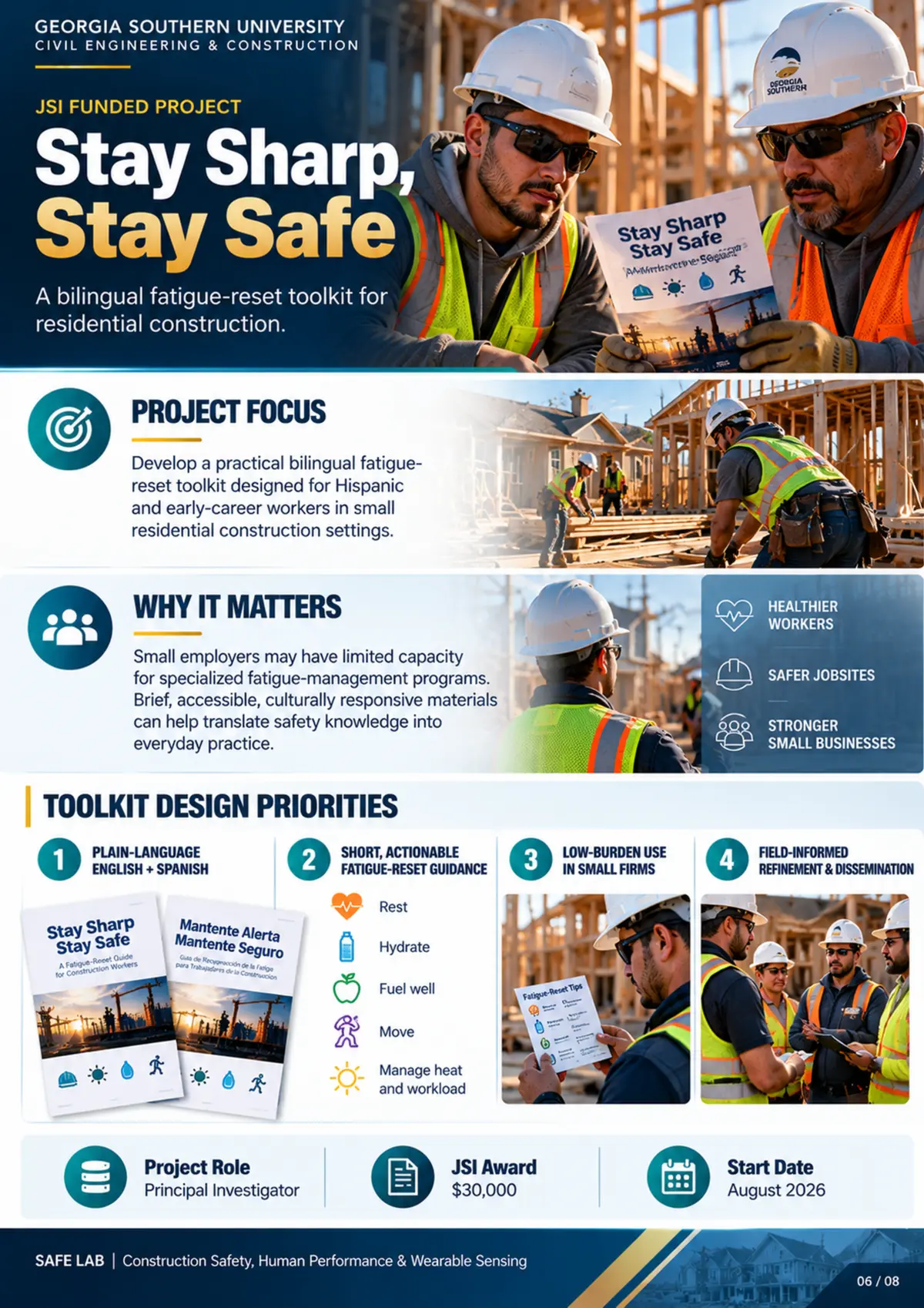
Stay Sharp, Stay Safe project poster showing the project focus, workforce need, toolkit priorities, and field-oriented delivery plan.
Stay Sharp, Stay SafeThe Job-Site Safety Institute-funded project develops a bilingual, low-burden fatigue-reset toolkit for residential construction.
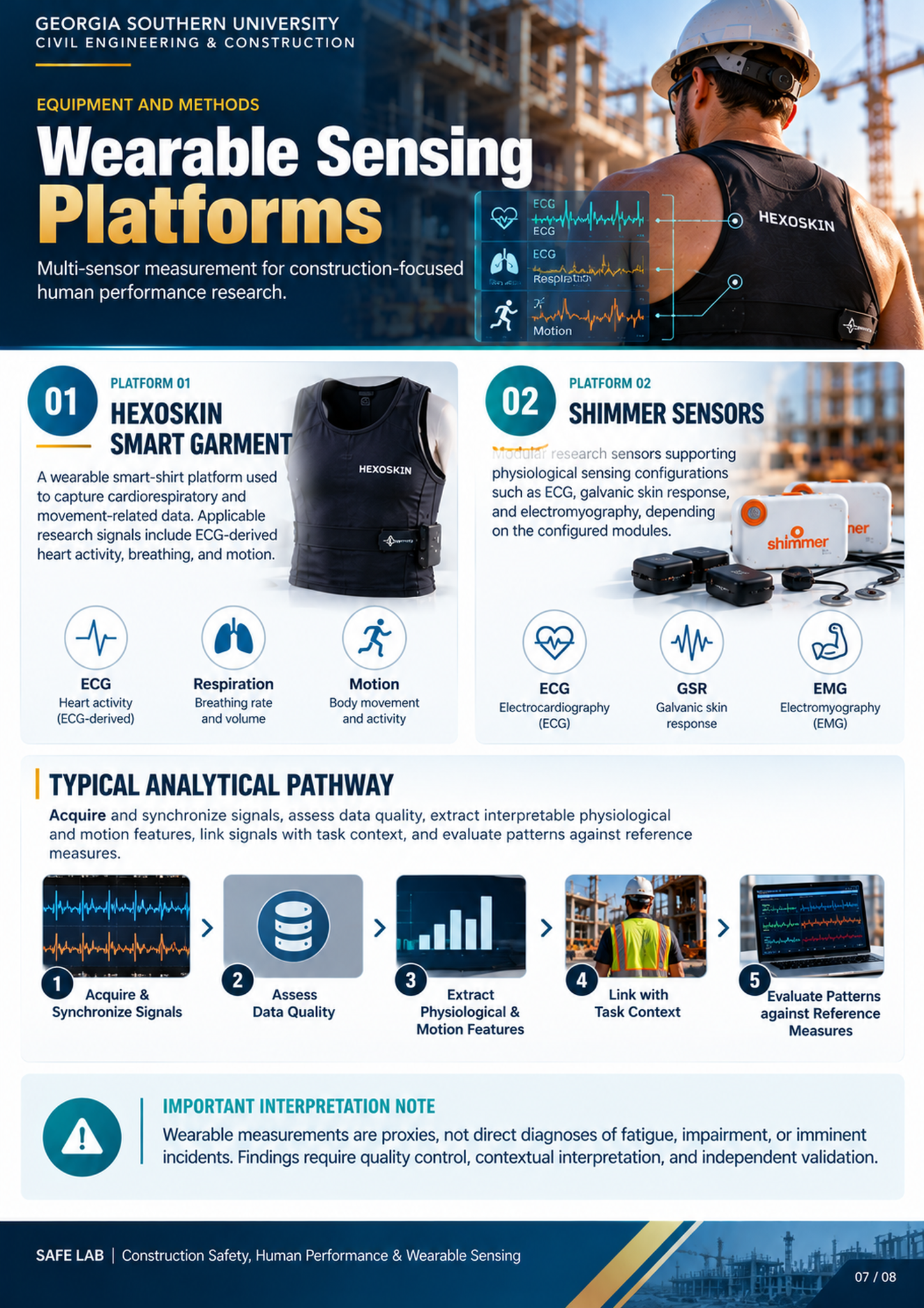
Wearable sensing platforms poster featuring Hexoskin and Shimmer equipment and a five-step analytical pathway from signal acquisition to pattern evaluation.
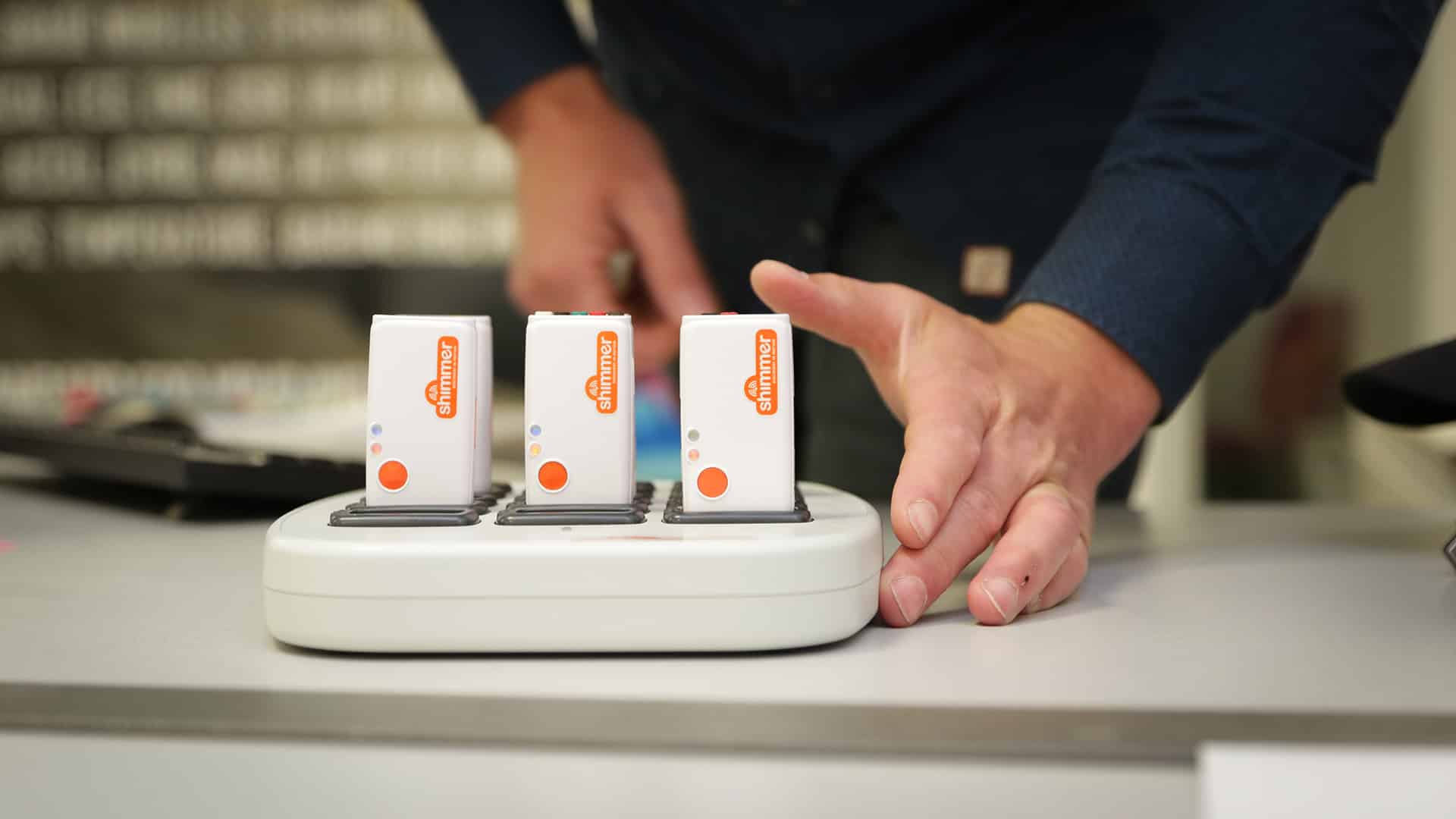
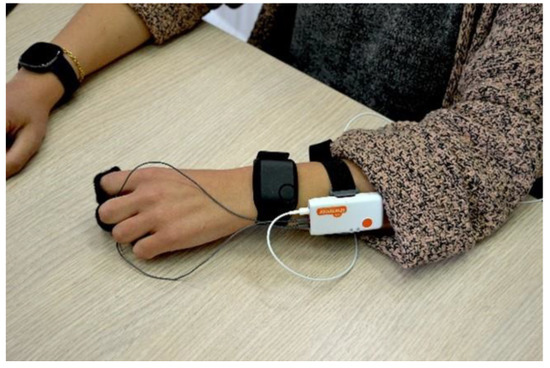
Wearable sensing platformsHexoskin and Shimmer support multimodal measurement of physiological and movement-related signals for construction-focused human-performance research.

STUDENTS & RESEARCH DEVELOPMENT

Learn through the complete research process.

Graduate and undergraduate involvement connects study design, literature review, measurement, analysis, scholarly writing, and presentation. Mentoring emphasizes research quality and professional confidence.

Mentoring & published outcomes ↗

DIRECTIONS FOR THE NEXT STAGE

  • Evaluate fatigue-reset strategies across construction tasks and field conditions.
  • Refine practical sensing approaches and validate their use in research.
  • Develop decision-support questions from measured evidence and worker experience.
  • Expand student participation through funded research and field partnerships.

LAB SCHOLARSHIP

Selected publications.

All publications ↗
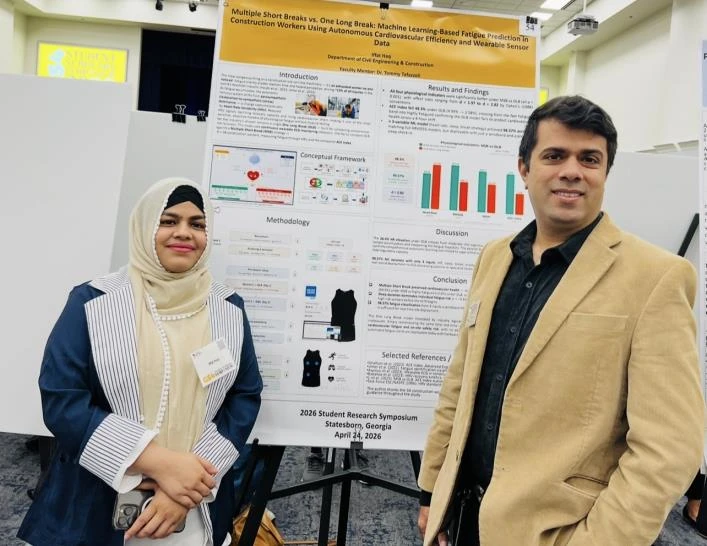
Iffat Haq and Tommy Tafazzoli beside a research poster on short breaks, fatigue prediction, and wearable sensing.
Student research in construction safetyIffat Haq and Tommy Tafazzoli at Georgia Southern’s student research symposium, presenting fatigue-management research.

STUDENT RESEARCH

Learning to ask—and present—a research question.

Iffat Haq’s symposium presentation connects short-break interventions, fatigue prediction, and wearable measurements. Student development includes framing the question, working with evidence, and communicating the work to an academic audience.

Student research & mentoring ↗
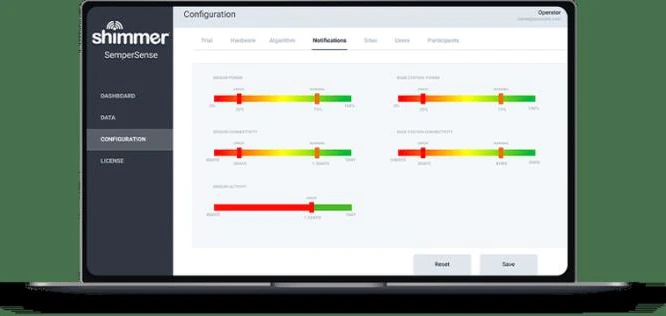
Inside the measurement platform
Laptop displaying a Shimmer sensor configuration interface.
Shimmer sensing interfaceAn example Shimmer software interface from the research narrative; shown to illustrate the measurement platform.

The software image illustrates the platform interface. Study methods and findings are described in the linked research papers.

RESEARCH · TEACHING · PROFESSIONAL ENGAGEMENT

Partner with the S.A.F.E. Lab.

Interested in field partnerships, wearable-sensing research, construction safety intervention, or graduate research collaboration? Let’s discuss the question and the setting.

Get in touch ↗