Understanding hazards is the starting point for sound construction decisions. These lectures connect OSHA, hazard analysis, and accident prevention with the practical demands of work on a construction site.
Instructor-developed lecture materials, organized for teaching, review, and professional learning.
Begin with safety foundations, develop approaches to hazard recognition and prevention, then examine the demands of specific construction activities. Select a week to read its materials below.
Weeks 1–4
Foundations of construction safety
01Week 124 pages · 1.9 MB
What is OSHA?
Introduces OSHA’s role in workplace safety, employer responsibilities, and worker rights. The lecture also introduces construction safety resources and the OSHA 30-hour training framework.
Examines the changing conditions of construction sites and hazards associated with trades, equipment, and materials. Introduces inspection priorities and the stages of an OSHA inspection.
Connects hazard recognition with worker motivation, communication, and leadership. Reviews construction safety and health program components, from policies to emergency planning.
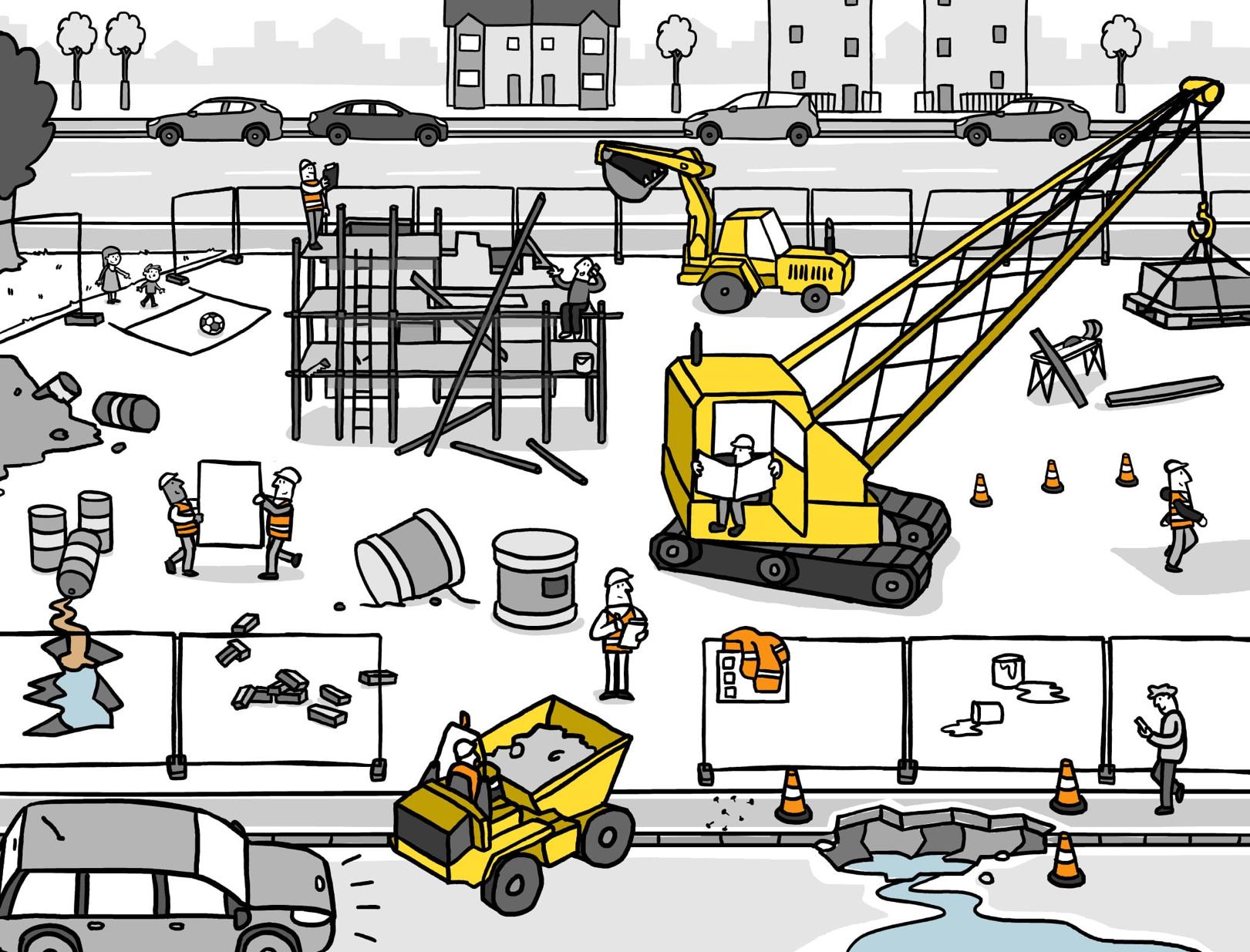
Uses a construction-site illustration to prompt hazard identification, then introduces hazard analysis, preconstruction planning, and accident documentation. Sample forms connect the discussion to project practice.
Examines hazard hunts, standard operating procedures, inspections, maintenance, and accident investigation. Examples show how findings become corrective actions.
Reviews personal protective equipment for different exposures and tasks, alongside ergonomics and safety training. Connects the selection of protection to hazards encountered at work.
Introduces accident causation and the costs of incidents, then examines fall and struck-by hazards. Compares protection systems and planning for work at height and around falling objects.
Examines electrical exposures, overhead power lines, grounding, and lockout/tagout. The second part addresses trench collapse, machinery, equipment rollover, and confined-space hazards.
Connects demolition planning with site assessment, structural conditions, utilities, and hazardous materials. Reviews dust and noise controls before introducing excavation hazards and underground utility identification.
Follows hazards from site mobilization and foundation work through scaffolding and steel erection. Reviews traffic, material handling, access, equipment, hot work, and forklift operations.
Mobilization and foundation hazards
Scaffolding access, stability, and falling objects
Examines masonry and concrete hazards, including lifting, dust, skin exposure, and ergonomics. Continues with stairways, ladders, cranes, rigging, and lifting operations.
Examines underground hazards, including ground instability, air quality, water, and access. Compares caissons and cofferdams and introduces the hazards associated with construction blasting.
Week 13 extends the sequence to exterior-enclosure work. Week 14 collects earlier lectures into a final-exam review document.
13Week 1346 pages · 5.9 MB
Exterior enclosure safety
Extends the course to building-envelope work. Reviews hazards associated with exterior cladding, glazing, roofing, wood framing, and sheathing, including access, handling, tools, and weather.
Brings earlier lecture material together in a single review document. Use weekly notes for focused study or open this compilation to revisit topics across the course.
Introduces OSHA’s role in workplace safety, employer responsibilities, and worker rights. The lecture also introduces construction safety resources and the OSHA 30-hour training framework.
The lecture materials use questions, visual examples, working documents, and construction activities to connect safety concepts with professional judgment.
Observe and identify
Site illustrations and photographs prompt students to identify potential hazards and explain what needs attention. Week 4 opens with a construction-site hazard analysis exercise.
Connect analysis to documentation
Jobsite hazard analysis forms, accident reports, hazard-hunt examples, and operating procedures make the role of safety documentation concrete.
Discuss, compare, and revisit
Question-led slides and linked instructional videos support discussion. Later lectures revisit safety principles in demolition, excavation, structural work, and building-envelope activities.
A prompt for observation and discussionWeek 4 asks students to analyze potential hazards in this construction-site illustration. Reproduced from the lecture notes, page 3; the original illustrator is not identified in the lecture slide.View the exercise in context ↗
Authorship & source acknowledgments
Dr. Tommy Tafazzoli developed these lecture materials for TCM 2430, Construction Safety. His original instructional organization, explanations, and teaching prompts are presented alongside cited standards, regulations, photographs, diagrams, and external learning resources. Third-party content remains attributable to its original creators.
The PDFs retain their original content, source acknowledgments, and links. Photographs and illustrations displayed here are excerpts from those materials; they are not presented as photographs taken by the instructor.