The resulting framework gives researchers and policymakers a common structure for setting priorities, harmonizing measurements, and designing more equitable indoor-air-quality programs.
What is missing from the evidence and governance of indoor air quality? This video introduces a PRISMA 2020-aligned hybrid synthesis of 105 records spanning 15 national contexts. The study combines bibliometric mapping and structured thematic synthesis to organize research gaps and priorities for future action.
Key findings from the paper
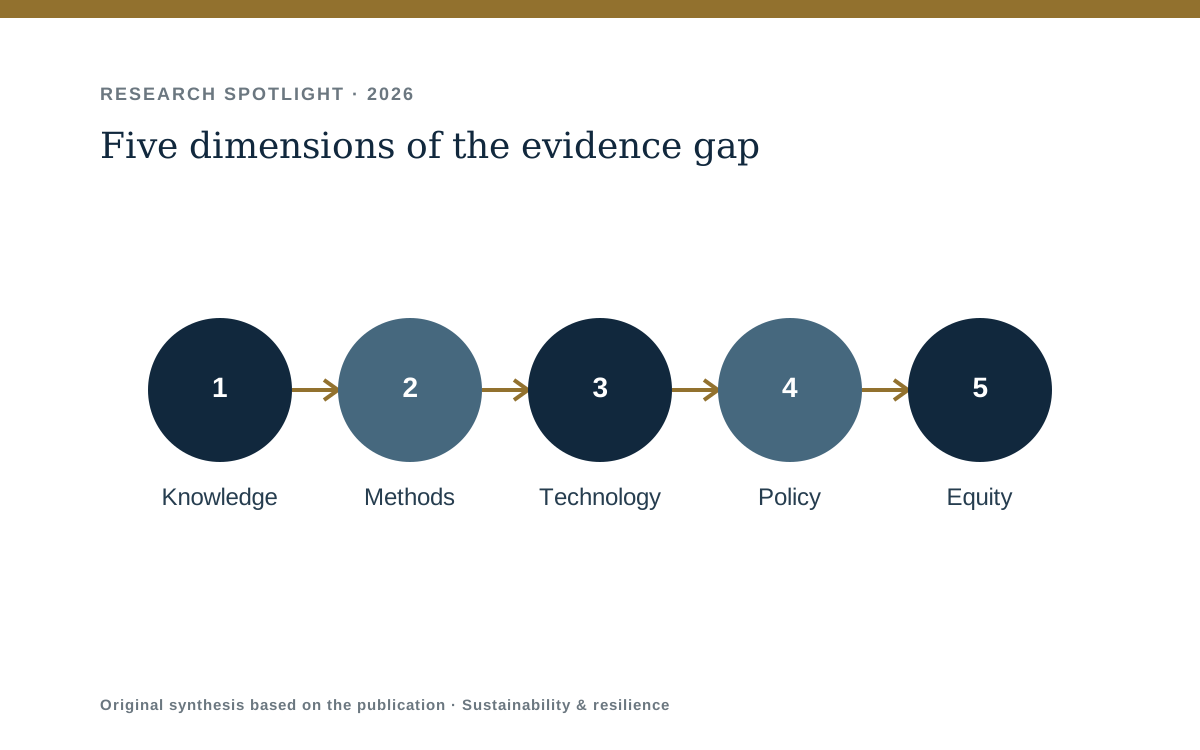
The Multi-Dimensional Gap Identification Framework identifies 20 gaps across five dimensions: knowledge, methods, technology, policy and implementation, and equity and urban context.
Recurring priorities include multi-pollutant assessment, comparable measurement protocols, verification of real-world intervention performance, and stronger representation of Global South populations.
The proposed Urban Indoor Air Quality Nexus connects pollutant dynamics, building systems, personal exposure, and governance. Both frameworks organize evidence and future work; neither is an externally validated predictive model.
People spend an estimated 80–90% of their time indoors, yet indoor-air-quality evidence remains divided across pollutants, buildings, interventions, and jurisdictions. This review asked where the most consequential research and governance gaps remain.
What we did
The team completed a PRISMA 2020-aligned hybrid synthesis of 105 records spanning 15 national contexts. Bibliometric mapping and structured thematic coding were combined in a seven-stage process to derive the Multi-Dimensional Gap Identification Framework and an organizing architecture for future action.
What we found
The framework organizes gaps across knowledge, methods, technology, policy and implementation, and equity and urban context.
Recurring problems include limited multi-pollutant assessment, inconsistent measurement protocols, and weak translation from laboratory performance to field performance.
The evidence also shows limited enforceable indoor-air standards and severe underrepresentation of Global South populations.
Why it matters
The resulting framework gives researchers and policymakers a common structure for setting priorities, harmonizing measurements, and designing more equitable indoor-air-quality programs. It is a reference architecture, not a validated prediction model. Read together, the question, method, and findings show how this publication fits within Tafazzoli’s broader program of connecting built-environment evidence with practical decisions. The page intentionally separates documented results from interpretation and directs readers to the complete paper for methodological detail.
Five dimensions of the evidence gap. This original synthesis graphic is based on the study’s documented question, method, or principal contribution; consult the paper for complete figures, labels, units, and uncertainty.
Original website synthesis based on the cited publication.
Indoor air quality: A comprehensive evidence-gap synthesis, policy failures, and a framework for future action
Published · 2026 · Journal article
Tafazzoli, M., Haq, I., Naeijian, F., Mousavi, E., & Goodarzi, M. (2026). Indoor air quality: A comprehensive evidence-gap synthesis, policy failures, and a framework for future action. Buildings, 16(17), 3347. https://doi.org/10.3390/buildings16173347